
The Image that Jesus gave us is to be a fount of Mercy for the world

The Image represents the infinite Divine Mercy and arouses the faithful to its imitation by personal works of mercy. The prayer inserted beneath the Image, “Jesus, I trust in You" instills into our souls trust in God in difficult times, to hope and have courage amidst dangers, and renders the soul magnanimous in the service of God.
By Bl. Michael Sopoćko, from his memoirs
The Image of Jesus, “the Divine Mercy”, is Our Lord as He appeared to the apostles in the Cenacle after His Resurrection. In front of the apostles, He instituted the Sacrament of Penance with the following words: “Peace be with you! As the Father has, sent me, I am sending you.” And with that he breathed on them and said, “Receive the Holy Spirit, whose sins you shall forgive, they are forgiven; whose sins you shall retain, they are retained.” (Jn 20:21-23)
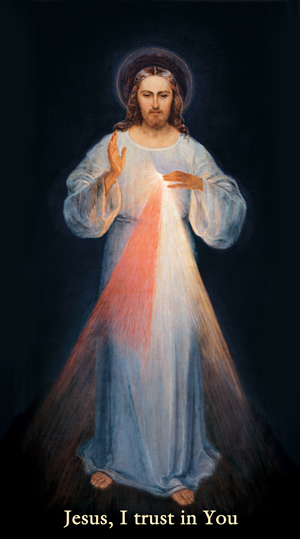
The same Image
The Image that appeared to Saint Faustina is the same Image that appeared to the apostles. The Image represents Christ coming toward us in a long white garment, His gaze looking downward, as it did from the cross, on all of mankind. With His left hand He draws aside the garment to expose His Heart, and from this heart falls two rays, one red (signifying blood), the other pale (signifying water). These rays are in effect the blood and water which flowed from the heart of Jesus on the cross, in the form of graces, the water purifying the soul from the stain of sin (the Sacraments of Baptism and Penance) and the blood giving new life, through the Sacrament of the Eucharist.
“These rays shield souls from the wrath of My Father. Happy is the one who will dwell in their shelter, for the just hand of God shall not lay hold of him." (St. Faustina’s Diary; 299)
Inexhaustible graces
This Image is also the Gospel for Low Sunday and a visible commentary on the liturgy of that day. It explains the anthem sung by the Church during Easter time as the priest sprinkles the congregation with holy water before solemn Mass: “Vidi aquam - I saw water coming forth from the right side of the temple, alleluia: and all to whom it came and said: alleluia: were saved. Give praise to the Lord, for He is good: for His Mercy endureth for ever.” This temple is Christ from whom flows the water of inexhaustible graces purifying souls from sins, as in the Sacraments of Baptism and Penance.
This Image explains also the Indroit and the Epistle of Low Sunday Mass. The Introit tells us that man must be born in the waters of Baptism to a new supernatural life, and reborn again by the Sacrament of Penance. The Epistle relates to us the testimony of the Three in heaven (the Father, the Son, and the Holy Spirit) and of the three on earth (the spirit, water and blood which left the dead body of Christ on the cross).
Thus, as we gaze upon the Image of Divine Mercy, we are reminded of Baptism with all its salutary effects, and of the Sacrament of Penance and the words of absolution which proclaim to us God’s reconciling Mercy. It also calls to mind indulgences which are an extra-sacramental remission of the temporal punishment, and likewise it reminds us of the Sacrament of Holy Orders instituted during the Last Supper and completed by Our Lord after His Resurrection, when He appeared to the Apostles in the Cenacle and granted them the power of absolution to be exercised in the Sacrament of Penance.
Easter's deepest mysteries
This Image represents the deepest mysteries of Easter: imparting to the Apostles the Holy Spirit who henceforth will operate in the Church, rule it, regenerate it, and bring sinners to new life, anoint prophets, and apply the merits of Christ’s sufferings and death to individual souls. The Image represents the infinite Divine Mercy and arouses the faithful to its imitation by personal works of mercy.
The prayer inserted beneath the Image, “Jesus, I trust in You," instills into our souls trust in God in difficult times, to hope and have courage amidst dangers, and renders the soul magnanimous in the service of God.
{shopmercy-ad}
You might also like...
What is the connection between Pope Leo XIV and one of the great holy wonder-workers or miracle workers in the history of our faith, St. Nicholas of Tolentino? He was was an Augustinian friar (like Pope Leo) and considered the patron of the Holy Souls in Purgatory.
On the feast day of St. James, Apostle, July 25, we share another example of how Jesus keeps His promises.
In the early 19th century, high in the mountains of Lebanon, Youssef Makhlouf dreamed of giving his life to Christ in a radical way. He became St. Charbel Makhlouf, OLM, whose feast we celebrate on July 24.