
Part 8: Why the Virginal Conception of Jesus Matters
Without belief in the fact of the virginal conception, it certainly would be much harder to sustain a coherent doctrine of the personal divinity, sinless redeeming sacrifice, and Davidic Messiahship of Jesus Christ. The virginal conception fits well with all of these gospel truths at once.
Part 8: Why the Virginal Conception of Jesus Matters
By Robert Stackpole, STD
In this weekly web series, Dr. Robert Stackpole, emeritus director of the John Paul II Institute of Divine Mercy, leads us step-by-step through the life of the Founder of Christianity, from Bethlehem to Galilee to Jerusalem. Along the way, we pause to consider in-depth the historical debate over the gospel stories of the virginal conception and nativity of Jesus, his message of the Kingdom, his embrace of persecution and death on the Cross, and his glorious bodily resurrection from the dead. Finally, we plunge into the great mystery of the Incarnation, and show how it actually shines through the whole gospel story from beginning to end.
Read the series from the beginning.
Assuming that Jesus was right that God is our loving Father, and assuming that the gospels were right that Jesus was conceived without human fatherhood (see the first three articles in this series), what could God the Father be trying to tell us by sending His Son into the world in this particular way?
In other words, what is the theological message expressed or implied in the New Testament about the miraculous origin of Jesus Christ?
Here we will digress from our historical investigation into the life of Jesus by looking at the theological significance of this amazing claim right at the start of the gospel accounts.
It all fits
There are several reasons for thinking that the coming of the Son of God into this world had to take place in some kind of miraculous manner, something very like a virginal conception by the power of the Holy Spirit. It all fits with everything else that we know about Christ, both his person and his mission.
First, If Jesus really was the divine Son sharing all the limitations and conditions of human life, then He personally pre-existed his own conception. In other words, alone among all human beings, Jesus had a personal and divine life that preceded His human conception and birth. Thus, it seems likely that the entry of this person into the world would have been different from that of anyone else, for in His case alone a supernatural, uncreated, divine person assumed our human condition. He was not a newly-created individual such as we are, but the eternal Son of God made flesh.
Some theologians worry that Jesus could not really be fully human if He did not have a human father. But it is doubtful that a person must be conceived in the ordinary, standard way in order to be authentically human.
For example, children conceived in a petri-dish as part of the process of in-vitro fertilization are still fully human beings, despite their non-standard origin (and this holds true whatever moral qualms we may have about the process itself). According to contemporary biology, the ovum (the unfertilized egg) in a woman’s womb contains all the genetic material needed for the development of a human child, and only needs to be “activated,” so to speak, by the male sperm and chromosomes to produce a child (and one of the ovum’s X chromosomes has to be turned into a Y chromosome to produce a male child).
Thus, if Jesus was miraculously conceived in the womb of his virgin mother by the power of the Holy Spirit, then he would receive an authentic human genetic inheritance through Mary (and this also means that he would have looked just like her, the very image of His blessed mother!).
What He needed
Second, Another reason why Jesus’ virginal conception is important is because it fits with what he needed to carry out his redeeming work as a saving sacrifice for the sins of the world.
A basic New Testament teaching is that from the day He was conceived until the day He died, Jesus was without sin of any kind (e.g. Jn 8:46; Heb 4:15; I Pt 1:19). To be a perfect sacrifice for human sin, He must Himself be without spot or blemish, like the sacrificial Passover lamb (Jn 1:29). Since our whole race has been wounded by the corruption of original sin passed down to us through the process of generation from our first parents, Adam and Eve (Ps 51:5; Rom 5: 12-21), a miraculous entrance into this world of some kind would seem to be required to preserve Jesus from inheriting that wound and corruption. Otherwise, His saving work would have been impossible.
This does not mean that to be conceived by the Holy Spirit without human fatherhood was the only possible way that God could preserve His incarnate Son from the wound of original sin (after all, Catholics believe that the Blessed Virgin Mary also was conceived without original sin, but in her case simply by a special outpouring of divine grace into her soul from the moment of her natural conception). But what this does mean is that the story of the virginal conception of Jesus fits perfectly with a necessary precondition for Him to be able to accomplish his redeeming work on behalf of sinful humanity.
Inherit the throne?
Third, If Jesus had been sired by Joseph, he would not have been able to claim the legal right to the throne of David, a pre-requisite for him to be the true Messiah. According to the prophecy of Jeremiah in 22:28-30, there could be no king in Israel who was a descendent of King Jeconiah, and Matthew 1:12 tells us that St. Joseph came from the direct line of Jeconiah. If Jesus had been fathered by Joseph in the natural way, therefore, he could not have rightly inherited the throne of David as the Messiah, since He would have been a blood relative of the cursed line of Jeconiah.
In short, without belief in the fact of the virginal conception, it certainly would be much harder to sustain a coherent doctrine of the personal divinity, sinless redeeming sacrifice, and Davidic Messiahship of Jesus Christ. The virginal conception fits well with all of these gospel truths at once.
In recent generations, and especially through the writings of the Protestant theologian Karl Barth in the 20th century, an even deeper meaning of the story has been recovered for us (a meaning that was taught by some of the early Fathers of the Church). The virginal conception beautifully expresses and exhibits the gospel message: Jesus the Savior was sent from above as a free, unmerited gift of God’s grace to a lost and broken world.
A new work
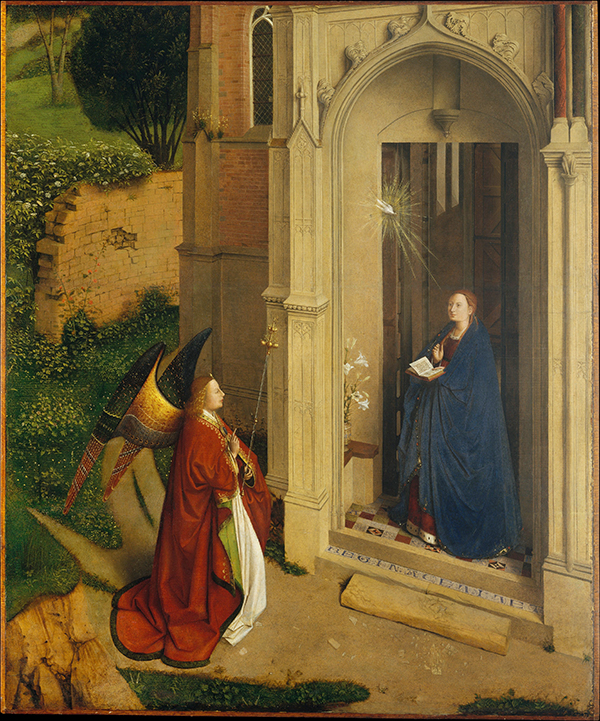
In St. Luke’s gospel, Jesus’ coming into the world is shown to be a new work of the Holy Spirit; as the angel said to Mary: “The Holy Spirit will come upon you, and the power of the Most High will overshadow you: therefore the child to be born will be called holy, the Son of God” (Lk 1:35). So Jesus comes into the world by a special, direct action of the power of God’s Spirit. No human work or merit was involved.
Jesus is not the supreme peak of natural evolution, nor humanity’s greatest religious or ethical achievement. Rather, He is a free gift of grace from a loving God who has not abandoned us, despite our rebellion against Him. Alone among human children, Jesus had His personal origin not in any natural process, but from above: from the gracious, saving initiative of God.
In addition to Barth, some Catholic New Testament scholars, such as Fr. Ignace De La Potterie, SJ, have argued that this same gospel message is implied in John 1:12. The Jerusalem Bible translated the passage like this: “to all who did accept [the Word] he gave power to become children of God, to all who believe in the name of him who was born not out of human stock, or urge of the flesh or will of man but of God himself.” Indeed, this form of John 1:12 (“was born” rather than “were born”) was familiar to many of the earliest Fathers of the Church, such as St. Justin Martyr, St. Irenaeus of Lyons, St. Hippolytus of Rome, and Tertullian. If their version is correct, then we have an allusion to the virginal conception of Jesus right in the first chapter of St. John’s gospel — one that shows that Jesus came into the world as a free gift of grace, and not from any mere human effort or natural process.
This same truth is also implied in St. Matthew’s gospel. Matthew tells us that Jesus (“Emmanuel … God with us,” Mt 1:23) came into the world as a special work of the Holy Spirit, and he directly links this fact to the name that the angel commanded Joseph to give him: “Joseph, son of David, do not fear to take Mary your wife, for that which is conceived in her is of the Holy Spirit; she will bear a son, and you shall call his name Jesus, for he will save his people from their sins” (1:20-21).
Rescue operation
What Matthew is telling us is that salvation, and the Savior himself, have come into the world as a free, unmerited gift of God, by the Holy Spirit. This is a rescue operation, and nothing that humanity can do can even partially achieve or accomplish it. The gift can only be received in faith, as Mary did at the Annunciation on behalf of us all (Lk 1:38): “Behold, I am the handmaid of the Lord; let it be to me according to your word.”
Moving ahead to the fifth century to the writings of the Church Father St. Cyril of Alexandria: in his work Quod unus sit Christus (724, c-d), he encourages his readers to understand the virginal conception account in the light of its significance to human salvation. Christ’s miraculous conception, initiating the saving drama of the new creation, shows that redemption comes as a divine gift. Human beings cannot inaugurate or carry through their own salvation. Just like the original creation of the world, St. Cyril tells us, the new creation in Christ is a divine work and pure grace — to be received on the human side with a trustful and grateful surrender of faith, just as Mary received the new life of Christ in her womb. [1]
Again, all this holds together if the virginal conception is accepted as an historical fact, and not simply as meaningful fiction. Where the full truth of this doctrine — both fact and meaning — is embraced and cherished, we are not likely to find Christians falling into the danger of believing that Jesus is merely an inspired teacher, or mankind’s highest ethical achievement, or the pinnacle of the evolutionary process of the human species.
Central Christian mystery
The truth of the doctrine of the Virgin Birth exhibits, and (by its facticity) protects the central Christian mystery: that Jesus Christ was sent into the world to save us, as a free gift from the gracious initiative and merciful love of our heavenly Father.
Of course, the people who first met Jesus in the carpenter shop in Nazareth, and first heard him preach by the Sea of Galilee, knew nothing of all this. But Jesus surely did: and it was all included in what he meant by calling God “Abba, my Father,” and seeing himself as the Father’s true and only Son.
Next: Part 9: Myth or Fact: Does it Really Matter?
Previous article.
Note
[1] On this see Gerald O’Collins, SJ, Christology. Oxford University Press, 1995, p .276-278.
{shopmercy-ad}
You might also like...
We celebrate one of the greatest mysteries of the life of the Blessed Virgin Mary on Aug. 15. How do we know her Assumption really happened?
In this weekly web series, Dr. Robert Stackpole leads us step-by-step through the life and historical evidence of the Founder of Christianity, from Bethlehem to Galilee to Jerusalem. Part 2: Jesus Called God His “Abba,” Father
In this weekly web series, Dr. Robert Stackpole leads us step-by-step through the life and historical evidence of the Founder of Christianity, from Bethlehem to Galilee to Jerusalem. Part 21: Jesus was the Kind of Messiah that No One Expected.