
This is How Mercy Triumphs Over Shame
I told the therapist that the comment did not follow Church teaching and was not based on Scripture. The Gospel writer St. Luke, for example, speaks of the Prodigal Son and calls for the reader to identify with Jesus who is tender and loving to the sinner, the poor, and the outcast.
We must make a distinction between guilt and shame. One feels guilt after making a bad choice; the choice was poor but that does not make the person bad. Some guilt is healthy if not carried to the extreme. The extreme would be to believe that the bad choices we've made serve as proof that we are bad! Such thinking leads to despair and frustration and deep emotional problems. It calls to mind the difference between St. Peter and Judas. Both denied our Lord, but one asked for forgiveness and became the first Pope, while the other ran off and hung himself.
Are you having trouble forgiving yourself and accepting God's mercy? You're not alone.
There was a nun in St. Faustina's convent who had doubts that the Lord had forgiven her for all of her past transgressions. Saint Faustina wrote in her Diary:
On the evening of the last day before my departure to Vilnius, an elderly sister revealed the condition of her soul to me. She said that she had already been suffering interiorly for several years, that it seemed to her that all her confessions had been bad, and she had doubts about whether the Lord Jesus had forgiven her. I asked her if she had ever told her confessors about this. She answered that she had spoken many times about this to her confessors and "the confessors are always telling me to be at peace, but I still suffer very much, and nothing brings me relief, and it constantly seems to me that God has not forgiven me." I answered, "You should obey your confessor, sister, and be fully at peace, because this is certainly a temptation."
But she entreated me with tears in her eyes to ask Jesus if He had forgiven her and whether her confessions had been good or not. I answered forceful, "Ask Him yourself, Sister, if you don't believe your confessors!" But she clutched my hand and did not want to let me go until I gave her an answer, and she kept asking me to pray for her and to let her know what Jesus would say about her. Crying bitterly, she would not let me go and said to me, "I know that the Lord Jesus speaks to you, Sister." Since she was clenching my hand and I could not wrench myself away, I promised I would pray for her. In the evening, during Benediction, I heard these words: "Tell her that her disbelief wounds My heart much more than the sins she committed." When I told her this, she began to cry like a child, and great joy entered her soul. I understood that God wanted to console this soul through me. Even though it cost me a great deal, I fulfilled God's wish (Diary of St. Faustina, 628).
Do you think that you have committed so many sins that God could never forgive you. The Lord told St. Faustina, "Remember, I did not allot only a certain number of pardons" (Diary, 1488).
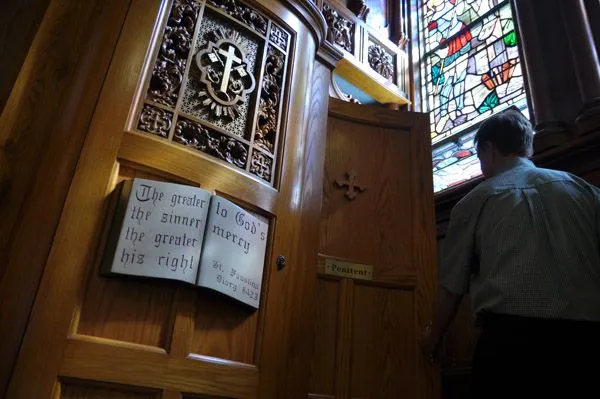
Do you think that you have committed the unforgivable sin? Jesus told St. Faustina, "The greater the sinner, the greater the right he has to My mercy" (Diary, 723).
Just accept God's unfathomable mercy in your life. Do as He told the woman caught in adultery:
Has no one condemned you? She said, "No one, Lord." And Jesus said, "Neither do I condemn you; go, and do not sin again" (Jn 8:10-12).
Dr. Bryan Thatcher is the founder of Eucharistic Apostles of The Divine Mercy (EADM), an apostolate of the Marian Fathers of the Immaculate Conception.
Learn how to start a Divine Mercy cenacle in your area.
You might also like...
The encounter between Mary Magdalene (feast day: July 22) and Jesus has been called the encounter "between misery and mercy." Dr. Bryan Thatcher explains.
When they saw the emergency, the Eucharistic Apostles of The Divine Mercy and the Healthcare Professionals for Divine Mercy leapt into action.
Introducing a new video teaching series!