
Highlights from the 21st Annual Divine Mercy Medicine, Bioethics, and Spirituality Conference

To register for the Conference and download the schedule, click here.
To become a Healthcare Professional for Divine Mercy, click here.
The 21st Annual Divine Mercy Medicine, Bioethics, and Spirituality Conference
"Exploring Compassion and Mercy in Healthcare"
Day 1: April 29, 2026
The Conference opened with Mass at 9 a.m. at the National Shrine of The Divine Mercy. Watch here.

Father Kaz Chwalek, MIC, spiritual director to the Healthcare Professionals for Divine Mercy apostolate of the Marian Fathers, was the main celebrant on this feast of St. Catherine of Siena. He noted today is also the feast of Polish nurse Blessed Hanna Chrzanowska (1902-1973), who changed Polish healthcare and the worldwide Catholic Church through her tireless and heroicefforts to serve her patients both medically and spiritually.
"Each one of us has a special journey, like Blessed Hanna. Who knows down the road you, too, may be beatified because of your selfless work on behalf of those who are sick and in need of God's mercy. We do not know," Fr. Kaz said. "But we do know one thing for sure: That when the Father sent the Son through the Incarnation, we have come to know God the Father in a human way in Jesus, to know His love, His tender care, His self-sacrifice. We have come to know the Lord. He is inviting us to follow Him, to be like Him. And that is what you do in your work, every day."
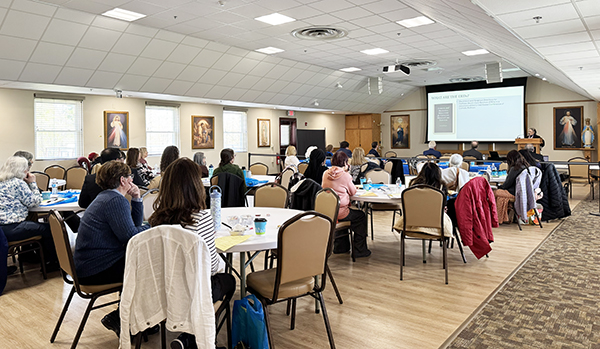
Conference participants gathered in the St. Faustina Center for the first day of talks. More than 50 are in attendance, with more than 40 joining in online. Father Kaz welcomed all, calling the conference a “wonderful opportunity to commune with the Lord." He prayed that "God will guide us throughout the day and the Conference in silence, in our thoughts, and in our hearts.
Father Anthony Gramlich, MIC, is present to hear Confessions if desired by conference participants.
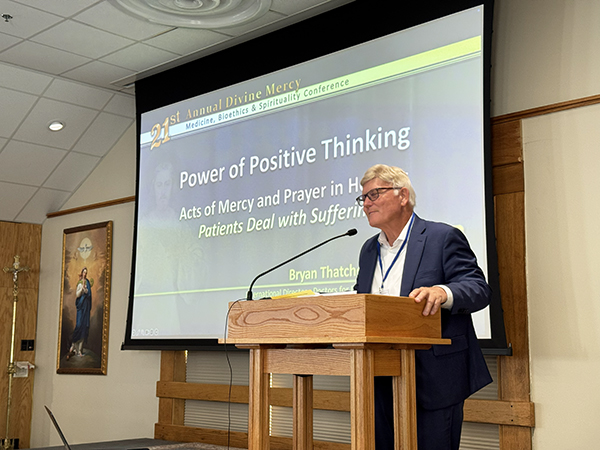
The first speaker was Bryan Thatcher, MD, international director of Doctors for Divine Mercy, and founder of Eucharistic Apostles of The Divine Mercy, an apostolate of the Marian Fathers. His topic was, "The Power of Positive Thinking: Acts of Mercy and Prayer in Helping Patients Deal with Suffering."
In his talk, Dr. Thatcher combined insights from brain chemistry and Divine Mercy theology and spirituality. “The world rejects the one anchor that gives peace beyond understanding, and that is Jesus Christ,” he said, quoting the Diary of Saint Maria Faustina Kowalska, 300, wherein Jesus says, “Mankind will not have peace until it turns with trust to My mercy.”
“Studies suggest that prayer, meditation, and performing good works (acts of kindness) can increase neurotransmitters” that alleviate pain and stress, he explained. “Gratitude triggers the brain’s reward system, releasing hormones and neurotransmitters that have tangible physical and mental benefits.”

The next speaker, the keynote for the day, was Allison LeDoux, MA, the director of the Respect Life Office for the Diocese of Worcester, Massachusetts. She spoke on "Guardians and Servants of Human Life: Upholding the 'Ethical and Religious Directives for Catholic Health Care Services' for the Renewal of a Culture of Life in Health Care."
LeDoux pointed out that the directives, given by the US Conference of Catholic Bishops (USCCB) to apply bioethical and pastoral principles to Catholic involvement in healthcare, are applicable both in Catholic healthcare institutions and to the work of Catholic professionals at secular institutions. Copies were made available to conference goers, and may also be found online. She noted the role of friend of the conference, her bishop, the Most Rev. Robert McManus of Worcester, in developing the directives.
LeDoux discussed the medical, scientific, ethical, philosophical, theological, and magisterial underpinnings of the directives, exploring such sources as Pope St. John Paul II’s landmark 1993 encyclical, Veritatis Splendor ("The Splendor of Truth").
She explained that the directives are applied by each diocesan bishop in their own diocese, taking into account both the Church’s unchanging teaching, her disciplines, and the needs and resources of their particular diocese.
“The Ethical and Religious Directives affirm what’s already in your heart as Catholic health care professionals,” LeDoux said. They are useful and applicable to all, she added, as they are rooted in the natural law. She offered an expressive quote from the document's introduction:
The mystery of Christ casts light on every facet of Catholic health care: to see Christian love as the animating principle of health care; to see healing and compassion as a continuation of Christ’s mission; to see suffering as a participation in the redemptive power of Christ’s Passion, death, and Resurrection; and to see death, transformed by the Resurrection, as an opportunity for a final act of communion with Christ.

After lunch, conference attendees heard from Dr. Ron Sobecks, a professor in the department of Hematology and Medical Oncology at Taussig Cancer Institute, part of the Cleveland Clinic. He offered a “Reexamination of Traditional Methods to Bring Forth Healing: Less is More.”
Drawing on case studies from his field of specialization, he offered a sense of the vital importance of a holistic approach to patient care.
Drawing from the Renaissance era thinker Paracelsus, Dr. Sobecks spotlighted the principle that substances given to patients aren’t necessarily toxic by nature, but rather that the dose determines the poison. That means that, often, less is more; given in a small enough dose, these can be deeply therapeutic.
Dr. Sobecks drew from the Diary of Saint Maria Faustina Kowalska, the Church Fathers, and more of the Church’s treasury of wisdom and revelation to apply some of the same lessons he’d drawn from medical science to Christian spirituality. Quoting Diary, 1488, he pointed to discouragement and exaggerated anxiety as deadly obstacles to spiritual health and maturation. Jesus told St. Faustina:
My child, know that the greatest obstacles to holiness are discouragement and an exaggerated anxiety. These will deprive you of the ability to practice virtue. All temptations united together ought not disturb your interior peace, not even momentarily. Sensitiveness and discouragement are the fruits of self-love. You should not become discouraged, but strive to make My love reign in place of your self-love. Have confidence, My child. Do not lose heart in coming for pardon, for I am always ready to forgive you. As often as you beg for it, you glorify My mercy.
The Eucharist, Dr. Sobecks continued, can sustain patients through their illness, treatment, and recovery as no other food. And just as cancer survivors need monitoring for relapse and renewed disease, so, too, do patients need spiritual monitoring, especially through examinations of conscience, to ensure ongoing, sustainable spiritual health and maturation.
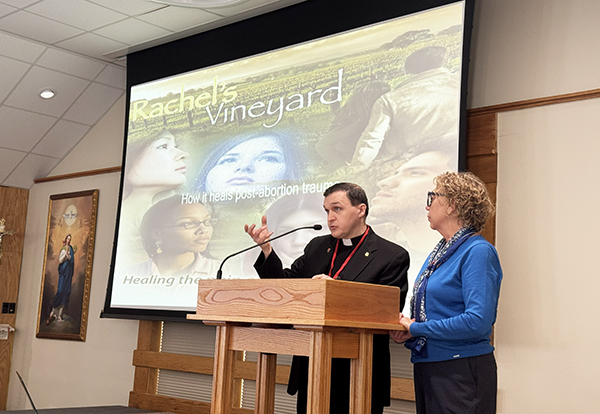
Next up were Fr. Anthony Gramlich, MIC, vice rector for Liturgy at the National Shrine of The Divine Mercy, and Joetta Dawson, a longtime coordinator of Rachel’s Vineyard post-abortive healing retreats for the Diocese of Springfield, for a talk on "Rachel's Vineyard Retreats: How It Heals Post-Abortion Trauma."
Father Anthony first got involved in bringing the Rachel’s Vineyard retreats to the Diocese of Springfield in 2007, and has been bringing Divine Mercy to post-abortive healing ever since.
The duo walked the conference-goers through the whole process of putting on a Rachel’s Vineyard retreat. Each Rachel’s Vineyard retreat, Fr. Anthony noted, needs a licensed therapist to help people work through their emotions, grief, and more from their abortion.
Joetta shared her personal testimony of going on a Rachel’s Vineyard retreat herself and, in threedays, finding healing and relief from the 20-year burden of an abortion she’d received in college. “When you truly encounter Jesus, and He enters into you, and you receive His Divine Mercy, you will be changed,” she said.
“Abortion doesn't happen in a vaccium,” Joetta added. "Participants explore what led to this. Through prayer, blessings, the Sacraments, times of reflection on Scripture, and more, incredible healing is possible on Rachel’s Vineyard retreats."

After that powerful presentation on effective post-abortive healing, conference-goers heard a presentation focused on forgiveness from Sr. Caterina Esselen, OLM, a member of St. Faustina’s own religious order. Sister Caterina addressed “The Treasure of Scripture and Saint Faustina’s Diary for Consolation, Strength, and Healing for Patients and Healthcare Professionals.”
Sister noted that May 13, 2026, would be the 45th anniversary of the assassination attempt upon Pope St. John Paul II. The Great Mercy Pope’s willingness to forgive the would-be assassin made headlines and front pages around the world.
Forgiveness is so necessary for both spiritual and sometimes even physical healing, Sr. Caterina explained. She drew upon her own life, when she had to forgive a distracted driver who’d hit her car and left her with pain for some time after, as well as examples from Scripture and the lives of saints who had to forgive.
“The only way out of this prison is to forgive those who have wounded us,” said Sr. Caterina. “We all need to be forgiven, and we all need to forgive.”
But forgiveness does not mean a wrong is made right. “Forgiveness is simply to leave it in the hands of God, to turn that person over to God," she said. “Do not be troubled if your emotions and feelings fight against forgiveness. Forgiveness is an act of the will."
Forgiveness is not an option if you want to be healthy, Sister concluded. She offered a concrete example from St. Faustina:
I am learning how to be good from Jesus, from Him who is goodness itself, so that I may be called a daughter of the heavenly Father. This morning, when someone hurt my feelings, I tried, in that suffering, to unite my will to the will of God, and I praised God by my silence. In the afternoon, I went for a five-minute adoration, when suddenly I saw the crucifix I have on my breast come alive. Jesus said to me, My daughter, suffering will be a sign to you that I am with you. My soul was greatly moved by these words. (Diary, 669)

After the 3 o’clock prayer, Dr. Christopher Klofft, an associate professor of theology at Assumption University, took the podium to discuss “The Inhuman Future of Being Human.”
He introduced the notion of transhumanism, of technology supposedly augmenting or enhancing human life, and said, “Science fiction serves a unique role in our society. Science fiction is important for us as a culture because what you see sci fi writers apprehensive about is likely what we’re moving toward.”
Dr. Klofft discussed several different ideas and areas where transhumanist thinkers and proponents perceived hope and opportunity, but that a more discerning eye could envision ethical and other challenges ahead. Areas of research included implanted computer chips, genetic manipulation, and more.
We must resist the temptation to reduce human beings to biological machines, said Dr. Klofft, explaining that we must always retain the vision of the human person as the imago Dei, made in the image of God.
“The poor will pay the price for the development of these technologies,” said Dr. Klofft, “and the rich will ‘benefit’ from these technologies.”
“Through the suffering of Christ, we recontextualize our own suffering,” he added, noting the challenge of proclaiming the value of suffering to the modern world.
“Technology has to be at the service of human dignity,” Dr. Klofft concludes. “Are we attempting yo cure what is ailing or are trying to change what is natural? Are we going to respect the design?… or are we going to say, 'Here is a product I can improve?'"

The next speaker was Marie Romagnano, MSN, RN, CCM-R, Founder of Healthcare Professionals for Divine Mercy; Assistant Clinical Professor, College of Our Lady of the Elms, School of Nursing; and Director, Medical and Humanitarian Case Management Operations for Ukraine Relief.

“There is not a current standardized spiritual curriculum available for those who work in healthcare,” noted Nurse Marie.
One is badly needed. “There’s no information in how to do this. People have to search.” Accreditation requires a spiritual assessment to be in place, but so much pf the world of healthcare neglects spiritual care.
Nurse Marie set out to both prepare the conference-goers to do a professional spiritual assessment of their patients, and also to run professional development in services with their colleagues to train others to adequately and professionally evaluate their patients for spiritual care.

Next up was Fr. Kazimierz Chwalek, MIC, BA, STB, STL (Cand.), director of the John Paul II Institute of Divine Mercy and spiritual director of Healthcare Professionals for Divine Mercy. Father Kaz spoke on "Divine Mercy Spirituality in Healthcare: Message, Devotion and Impact for Patients and Healthcare Professionals."
"We put the spiritual into healthcare," Fr. Kaz reminded the conference-goers. "Our lives are dedicated to caring for the sick and the dying. We have many opportunities for being the instruments of God's mercy towards them."
But trust is essential. "We must be ever aware of and count on the indispensible source of the help we need in fulfilling our ministry to them," Fr. Kaz urged. "Through St. Faustina, Jesus reminds us: It is in My Passion that you must seek light and strength (Diary, 654). The Lord calls us to hope and trust in His compassion and love without wavering."
Day 1 of the conference concluded with the Very Rev. Chris Alar, MIC, Provincial Superior, Blessed Virgin Mary, Mother of Mercy Province, speaking on "Why Charlie Kirk?", his Mass homily from Sept. 11, 2025.
{shopmercy-ad}
You might also like...
What is the connection between Pope Leo XIV and one of the great holy wonder-workers or miracle workers in the history of our faith, St. Nicholas of Tolentino? He was was an Augustinian friar (like Pope Leo) and considered the patron of the Holy Souls in Purgatory.
On the feast day of St. James, Apostle, July 25, we share another example of how Jesus keeps His promises.
In the early 19th century, high in the mountains of Lebanon, Youssef Makhlouf dreamed of giving his life to Christ in a radical way. He became St. Charbel Makhlouf, OLM, whose feast we celebrate on July 24.