
On this day, the Divine Mercy Image was revealed

As Divine Mercy Sunday approaches, it is a good time to make sure you’ve got a Divine Mercy Image in your home. Order your Divine Mercy Image today by visiting DivineMercyArt.org or by calling 1-800-462-7426.
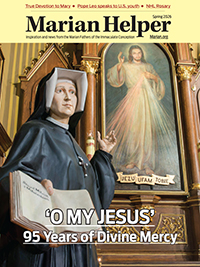
Read all about the 95th anniversary in the electronic version of Marian Helper magazine!
By Fr. Kazimierz Chwalek, MIC, and David Came
Ninety-five years ago, on Feb. 22, 1931, Jesus appeared to a simple, uneducated Polish nun known today as St. Faustina. The vision led to the painting of The Divine Mercy Image. This Image has become a source of amazing graces for souls who trust in Jesus by venerating or honoring it.
On that day, Sr. Faustina Kowalska, a Sister of Our Lady of Mercy, was in her convent in Plock, Poland, when Jesus appeared to her:
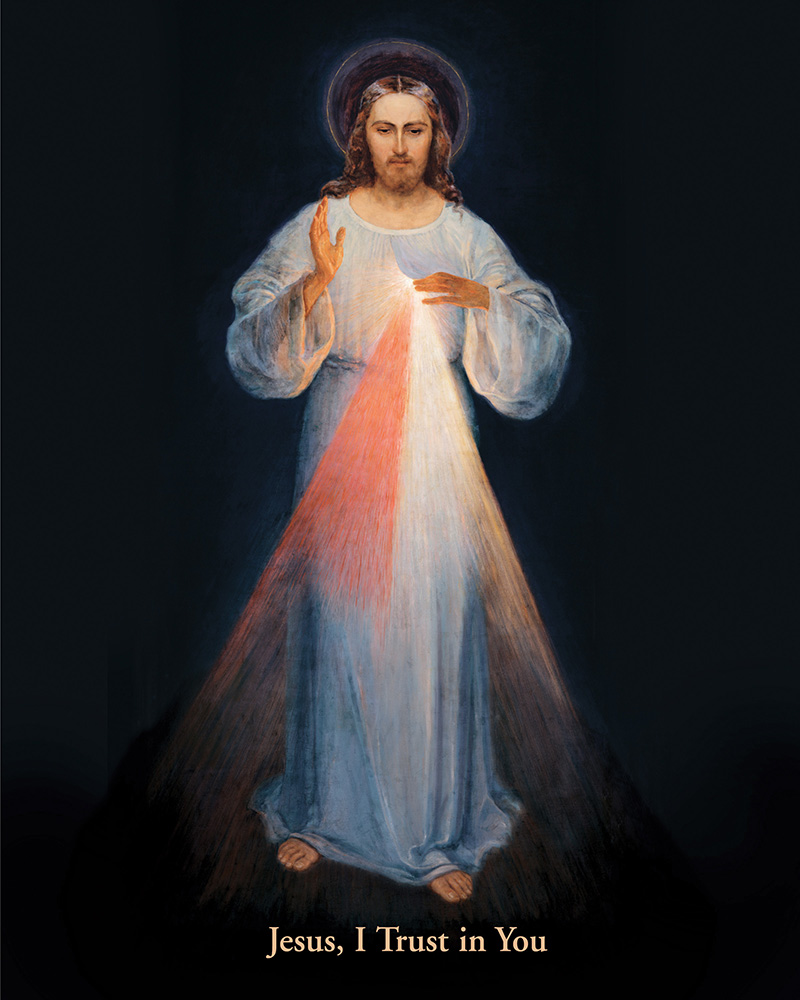
I saw the Lord Jesus clothed in a white garment. One hand was raised in the gesture of blessing, the other was touching the garment at the breast. From beneath the garment slightly drawn at the breast, there were emanating two large rays, one red, the other pale. In silence I kept my gaze fixed on the Lord; my soul was struck with awe, but also with great joy. After a while, Jesus said to me: "Paint an image according to the pattern you see, with the signature: Jesus, I trust in You. I desire that this image be venerated, first in your chapel, and [then] throughout the world." - Diary of St. Faustina, 47
The merciful Savior also promised that the soul who will venerate this image "will not perish" and even promised such a soul "victory over [its] enemies already here on earth, especially at the hour of death" (Diary, 48).
Sister Faustina didn't know what to do after receiving these astounding revelations. She tried to paint Jesus herself and failed. Then she started asking her fellow sisters in the convent, "Can you paint?" Her superior was concerned about Sr. Faustina causing a commotion in the community, so she had her transferred to the religious house in Vilnius, Lithuania.
A vessel for graces
In Vilnius, Sr. Faustina confided in Fr. Michael Sopocko as her confessor and spiritual director. He first ordered psychiatric tests for Sr. Faustina to make sure that she was not delusional. Once the tests confirmed she was normal, he began to guide her in fulfilling the Lord's requests concerning the image.
One big step was helping Sr. Faustina to recognize that the Lord Jesus was not just giving the image to her, rather He was giving it to all people. As Jesus told her, "I am offering people a vessel with which they are to keep coming for graces to the fountain of mercy. That vessel is this image with the signature: 'Jesus, I trust in You' " (Diary, 327).
Realizing this, Fr. Sopocko commissioned the artist Eugene Kazimirowski to paint the image under Sr. Faustina's direction. It was completed in 1934, and is now known as the original Vilnius image. When Sr. Faustina first saw the image, she wept in disappointment, asking the Lord Jesus, "Who will paint You as beautiful as You are?" But Jesus told her, "Not in the beauty of the color, nor of the brush lies the greatness of this image, but in my grace" (Diary, 313).
Today, there are many different versions of The Divine Mercy image, including the Vilnius Image (below). And no matter which version of the image we prefer, Jesus is telling us that it is a vehicle of His grace if we revere it with trust in His mercy.
The meaning of the image
Along with finding an artist to paint the image, Fr. Sopocko asked Sr. Faustina about the meaning of the two rays. She, in turn, asked the Lord and He told her:
"The two rays denote Blood and Water. The pale ray stands for the Water which makes souls righteous. The red ray stands for the Blood which is the life of souls. These two rays issued forth from the very depths of My tender mercy when My agonized Heart was opened by a lance on the Cross." - Diary, 299
These two rays coming from the pierced Heart of Jesus correspond exactly with the Passion account in John's Gospel where we read of a Roman soldier thrusting his lance into Jesus' side and "blood and water" flowing out (Jn 19:34).
For our salvation
Do you realize what is happening here? The Blood and Water pouring forth is the gift of the Holy Spirit for our salvation! Not only is the grace flowing, but the image helps us to understand what took place for our salvation - Christ died on the cross. However, that's only one dimension. The image also captures the risen Christ, with the Blood and Water flowing from His side now transformed into glorious, healing rays.
Even more, the Water signifies Baptism, "which makes souls righteous," while the Blood points to the Eucharist as "the life of souls." And these are the most important Sacraments of our Christian faith. Thus, this miraculous image is a powerful summary of our Christian faith.
In The Spirit of the Liturgy, Cardinal Joseph Ratzinger, the future Pope Benedict XVI, speaks of sacred images or icons of Christ in just this way. In fact, it is as if Cardinal Ratzinger had The Divine Mercy image in mind when he wrote:
The center of the icon of Christ is the Paschal Mystery: Christ is presented as the Crucified [One], the risen Lord, the One who will come again, and who here and now hiddenly reigns over all.
Take a minute. Gaze on The Divine Mercy image. Read these words again. In this image, we glimpse the saving power of Jesus in the Easter mystery!
Seeing Christ with new eyes
Also, in The Spirit of the Liturgy, Pope Benedict encouraged "a new kind of seeing" in which we prayerfully gaze upon an image of the Lord, recognizing that it is not a photograph, but a window that opens onto eternity. He speaks of "an encounter in faith with the new reality of the risen Christ," "an interior gazing" of the heart and soul upon the Lord Jesus in the image.
Let this "new kind of seeing" guide your response to Jesus in The Divine Mercy image:
Show trust in Jesus by venerating the image. Give the image a place of honor in your home, office, and parish church. Venerate the image by reverently kneeling or bowing whenever you pass by it. Along with venerating large framed images, consider keeping a prayercard with the image in your wallet or purse. Take it out throughout your day and gaze on the merciful Savior. Give veneration of the image special prominence on Divine Mercy Sunday in your parish and at home (see Diary, 341). Whenever you venerate the image, say, "Jesus, I trust in You!" Hand over all of your problems and fears to the Lord Jesus.
Let the image remind you to perform works of mercy. Just as Jesus has shown you His mercy through His death and Resurrection, now - through the image - He reminds you to show mercy to others. "By means of this image I shall grant many graces to souls," Jesus told St. Faustina. "It is to be a reminder of the demands of My mercy, because even the strongest faith is of no avail without works" (Diary, 742). So, as you gaze upon The Divine Mercy image, see in Jesus your brother and sister in need. Then, as you perform your works of mercy, do them out of love for the Lord Jesus.
In these ways and more, keep gazing upon Jesus. Behold the merciful Savior who died and rose for you. Let this image of the Lord Jesus keep transforming you until you behold Him face to face in Heaven. "Jesus, I trust in You!"
{shopmercy-ad}
You might also like...
What is the connection between Pope Leo XIV and one of the great holy wonder-workers or miracle workers in the history of our faith, St. Nicholas of Tolentino? He was was an Augustinian friar (like Pope Leo) and considered the patron of the Holy Souls in Purgatory.
On the feast day of St. James, Apostle, July 25, we share another example of how Jesus keeps His promises.
In the early 19th century, high in the mountains of Lebanon, Youssef Makhlouf dreamed of giving his life to Christ in a radical way. He became St. Charbel Makhlouf, OLM, whose feast we celebrate on July 24.