
Day 2: Highlights from the 21st Annual Divine Mercy Medicine, Bioethics, and Spirituality Conference

To register for the Conference and download the schedule, click here.
To become a Healthcare Professional for Divine Mercy, click here.Highlights from Day 1, April 29, 2026: click here.
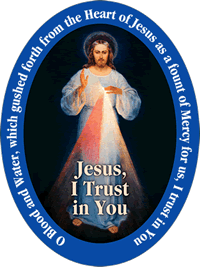
The 21st Annual Divine Mercy Medicine, Bioethics, and Spirituality Conference
"Exploring Compassion and Mercy in Healthcare"
Day 2: April 30, 2026
Today began with Mass at 9 a.m. at the National Shrine of The Divine Mercy. Watch here.
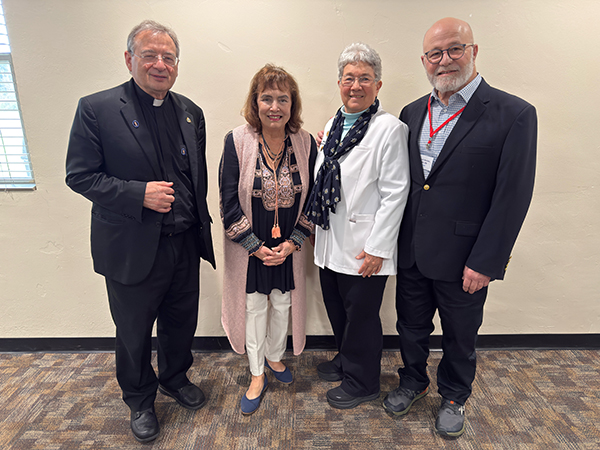
The lead celebrant and homilist was Fr. Anthony Gramlich, MIC, vice rector for Liturgy at the National Shrine of The Divine Mercy. He talked about his experience of being a patient and being asked for his blessing by one of the nurses attending him. What a blessing, he said, to find faith alive amongst healthcare professionals!
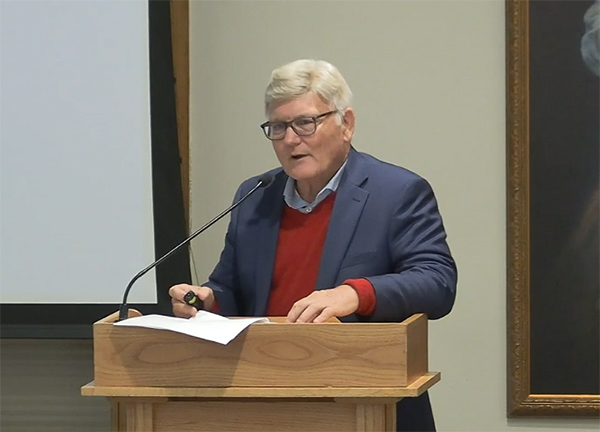
Our first speaker today is Bryan Thatcher, MD, International Director, Doctors for Divine Mercy, and founder, Eucharistic Apostles of The Divine Mercy. His topic: "Adoption as an Alternative to Abortion — Preparation for Healthcare Professionals When Counseling Women with Unintended Pregnancy."
He shared the testimony of women who had experienced unintended pregnancy and were pressured to abort. Conference-goers watched a moving conversation with Melissa Coles from Dr. Thatcher's "Mercy Unbound" series. Twenty-five years ago, Melissa was a pregnant teenager who walked into an abortion clinic, got up on the table, then walked out. She eventually put her baby up for adoption, and 19 years later reunited with her son. She will never forget the "Adoption Option." Watch here.

Next up is today's keynote talk by Christopher Klofft, PhD., Associate Professor of Theology at Assumption University. His topic: "The Fire of God’s Mercy and Its Implications for the Spiritual Health of Patients."
He spoke frankly about how dark and difficult his research often is these days into the ethical and bioethical questions coming to the forefront as technology evolves. His remedy is to conclude his research by taking up the Gospels and finding the light of Christ therein.
Dr. Klofft focused his presentation on the Gospel of Matthew and drew deeply from the work of Fr. Simeon, the former Erasmo Leiva-Merikakis.
“Mercy is not just a feeling,” but a spontaneous creative movement, Dr. Klofft explained. Mercy seeks to restore something that was lost, and effects a transformation. God shows His omnipotence through having mercy.
Dr. Klofft then surveyed the traditional stages of Christian mysticism (purification, illumination, and union), citing St. John of the Cross.
“We have to let God come to us,” said Dr. klofft, which will transform us and empower us to share God’s transforming grace with others, as well.
Be inspired by St. Faustina, he concluded: "O my Jesus, transform me into Yourself by the power of Your love, that I may be a worthy tool in proclaiming Your mercy" (Diary of Saint Maria Faustina Kowalska, 783).

Following lunch, the Most Rev. Joseph Roesch, MIC, MA, STL, Superior General of the worldwide Congregation of Marian Fathers of the Immaculate Conception of the Most Blessed Virgin Mary, offered a talk, via video, on "The Rosary: An Important Component of the Spirituality of the Healthcare Professional."
Father Joe pointed to the magisterial and personal witness of Pope St. John Paul II, the Great Mercy Pope, whose love of Our Lady and her Rosary was public, long-standing, and emphatic.
He also turned the attention of conference-goers to the words of Our Lady of Fatima, also known as Our Lady of the Rosary. She requested the daily Rosary for peace in the world, and for the conversion of poor sinners, as well as to make reparation for sins.
Father Joe pointed to the connections between healing, spiritual health, and peace in the world, all of which can be served by Our Lady’s Rosary.
"The Rosary is such an important tool in our arsenal," Fr. Joe concluded. "Let's unite with Our Lady, pray for peace, pray for the conversion of all hearts, and pray for our good work as healthcare professionals."

Next, Sr. Caterina Esselen, OLM, a member of St. Faustina’s own religious order, spoke on "The Role of the Divine Mercy Image in Promoting Healing for Patients and Healthcare Professionals."
She emphasized that graces do flow from the veneration if the Divine Mercy Image, with testimony after testimony of graces received in the simple devotion of the faithful to Christ, making use of this special sacramental. She shared the incredible story of Ugo Festa and his miraculous healing while praying before the Divine Mercy Image.
Sister Caterina then discussed different elements of the Image, such as the gaze of Jesus, the red and pale rays flowing from His pierced Heart and side, and more. Drawing deeply on the Diary of Saint Maria Faustina Kowalska, Sister urged conference-goers to trust in Jesus, His promises, and His grace. "Know that the Lord desires to save us, to restore us in body and soul," she said.
"The Divine Mercy Image is a reminder we should run towards God, not away from Him like Adam and Eve. Jesus wants to be with us, in light and in darkness. He is with us!"
Sister's talk is especially fitting today, the 26th anniversary of the canonization of St. Faustina by Pope St. John Paul II, and the announcement of the universal feast of The Divine Mercy!

The next talk was given by Allison LeDoux, the director of the Respect Life office of the Diocese of Worcester. She addressed “Facing the Reality of Death with the Confidence of Faith,” drawing from the chapter of the US Bishops’ Ethical and Religious Directives dealing specifically with end of life care and moral decision-making.
LeDoux recommended conference-goers also turn to the National Catholic Bioethics Center (NCBC), a trusted Catholic resource for bioethics in accord with both the natural law and Church teaching. The NCBC has a 24/7 ethics consultation service, as well as helpful, detailed articles on controversial bioethical issues and other resources.
She acknowledged that once a patient comes to the ending of their life, care can get a little complicated, and both healthcare professionals as well as patients and their families can use all the help they can get.

After a short break, Dr. Ron Sobecks took the podium to discuss “Discernment of the Most Effective Healing Approaches in an Era of Medical Innovation.” He began by doing a deep dive into the science of the immune system.
Alongside the deep scientific overview, Dr. Sobecks spoke of it as “God’s gift,” pairing faith and reason along the lines of the teaching of St. John Paul Ii’s landmark 1998 encyclical letter Fides et Ratio ("Faith and Reason").
Dr. Sobecks began to explore the cutting edge immunotherapy treatments being developed especially to treat cancer. He focused on the specific immunotherapy treatment involving “checkpoint inhibitors.” He then pivoted to discuss the importance of spiritual immunity, which is enhanced by the trials we encounter.
"We need to be prepared by prayer, study of our faith, the Sacraments, the Divine Mercy message and devotion, and more if we are to remain spiritually healthy today," he said. "Divine Revelation has given us enlightenment about the sacred mysteries and truth that has always existed."

Next, Nurse Marie Romangano took the podium to discuss “What to Do When the Patient is Dying.” She immediately spotlighted the immense graces available to patients through the veneration of the Divine Mercy Image.
“Divine Mercy is a way of life,” Nurse Marie explains, and even beyond using sacramentals in patient care, healthcare professionals have to embody Divine Mercy for their patients, challenging though that is.
Drawing on case studies and her long experience, Nurse Marie offered insight into best practices for using Divine Mercy in the spiritual care of patients, especially when confronted by sudden death or crisis. In particular, she praised the ongoing recovery of Br. Giuseppe, MIC ("Cameraman Giuseppe"), who suffered a stroke earlier this year.
“We need spiritual health to make life changing decisions for our patients," noted Nurse Marie, and to help patients be spiritually healthy themselves. Even if a patient is unconscious, she noted, they can still hear you, so pray the Divine Mercy Chaplet.
Following Nurse Marie's talk, Dr. Kathleen Scoble, a member of the planning committee for the conference and dean emerita, Elms College School of Nursing. offered some fascinating statistics:
- In some states, more than 30 percent of all the hospital beds are in Catholic facilities. In some states, it is over 40 percent.
- 1 in 6 patients hospitalized are cared for in a Catholic hospital.
- Catholic hospitals handle 19 million emergency department visits per year.
- 20 percent of all adults in the United States decribe themselves as Catholic, according to Pew Research.
"So, more than likely, you will care for a Catholic parient, who needs spiritual care that we have hopefully learned so much about in these last couple of days," she said.

Father Kaz Chwalek, MIC, returned to the podium to deliver the final talk of this year's conference, "St. Faustina and The Meaning of Suffering."
Saint Faustina, he reminded the conference-goers, suffered greatly from tuberculosis for several years. She suffered physical as well as spiritual pain on account of others. "Last night I was in such pain that I thought it was the end," she wrote, one year before she died (Diary, 999). She often lost consciousness due to pain. But she offered her suffering "to plead the mercy of God for poor sinners and to beg for strength for priests" (953).
That's a wrap! Thank you for joining us!
{shopmercy-ad}
You might also like...
What is the connection between Pope Leo XIV and one of the great holy wonder-workers or miracle workers in the history of our faith, St. Nicholas of Tolentino? He was was an Augustinian friar (like Pope Leo) and considered the patron of the Holy Souls in Purgatory.
On the feast day of St. James, Apostle, July 25, we share another example of how Jesus keeps His promises.
In the early 19th century, high in the mountains of Lebanon, Youssef Makhlouf dreamed of giving his life to Christ in a radical way. He became St. Charbel Makhlouf, OLM, whose feast we celebrate on July 24.